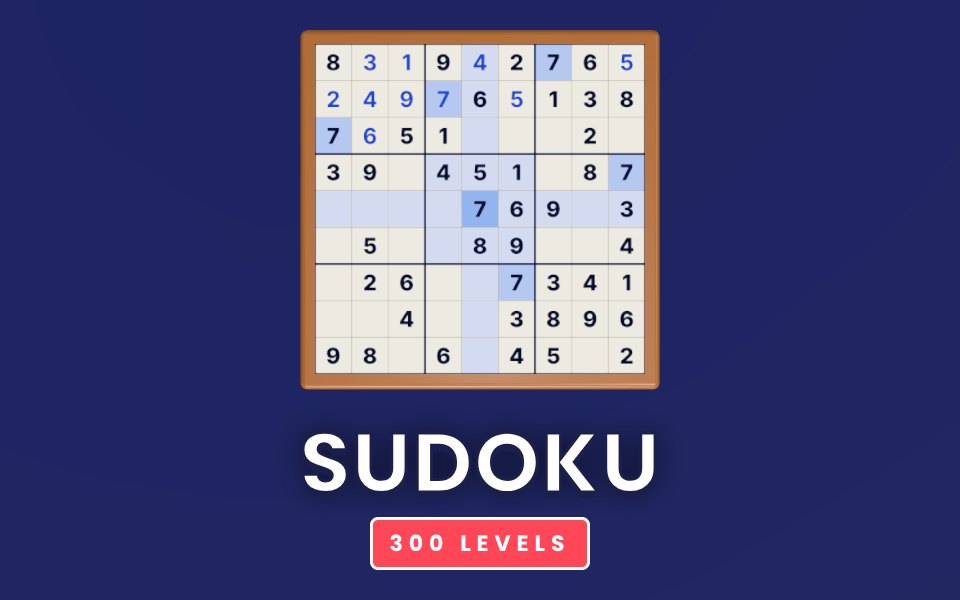
Sudoku is the classic number puzzle with hundreds of levels that get harder as you go. Fill the 9 by 9 grid so that every row, every column and every 3 by 3 box contains the numbers 1 to 9 exactly once. Every puzzle is generated to have exactly one solution, so you never need to guess. Pencil notes, highlighting of the selected row, column, box and matching numbers, and an undo button make it comfortable to play on a phone or a computer. Three mistakes end the level.
Open source: this game is based on sudoku.js by Rob McGuire-Dale (MIT License). Rebuilt in 3D for Xons Play.
How to play
Tap a cell, then tap a number (or type 1 to 9).
Turn on Notes to write small candidate numbers.
Every row, column and 3 by 3 box needs 1 to 9 once.
Three wrong numbers end the level.
Tips
Start with rows, columns and boxes that are nearly full.
Use notes to find cells with only one possible number.
Look for a number that can only go in one place inside a box.
The complete Sudoku guide
This is the complete guide to Sudoku on Xons Play: what the game is, how the controls work, a visual walkthrough with real screenshots, strategy from beginner to advanced, the mistakes most players make and how to avoid them. Read it from top to bottom before your first game, or jump to the section you need.
At a glance
Players1 player
GenrePuzzle
Difficulty Medium
Typical session3 to 25 minutes per level
Key skillsLogic, patience, concentration
GoalBeat your best score
Works onPhone, tablet, PC
PriceFree, no download
Visual guide to Sudoku
How a game works, step by step
1
Tap a cell, then tap a number (or type 1 to 9).
2
Turn on Notes to write small candidate numbers.
3
Every row, column and 3 by 3 box needs 1 to 9 once.
4
Three wrong numbers end the level.
Controls diagram
Touch screen
Tap works the same as clicking.
Mouse
Tap a cellSelect it
Tap 1 to 9Enter a number
Keyboard
1 to 9Enter a number
ArrowsMove the selection
NToggle notes
BackspaceErase
Controls for Sudoku on phones, tablets and computers.
Why people love Sudoku
Puzzle games offer a special kind of satisfaction: the moment a problem that looked impossible suddenly makes sense. Sudoku is full of those moments. Each level is a small, self-contained challenge with a clear answer, and the difficulty builds gently so you are always learning. There is no time pressure unless you want it, which makes puzzles a calm, focused break that still leaves your mind feeling sharper afterwards.
The objective
Fill the 9 by 9 grid so every row, column and 3 by 3 box contains the numbers 1 to 9 exactly once. Three wrong numbers end the level.
Background: where Sudoku comes from
Sudoku needs no maths at all, only logic and patience. Every puzzle here has exactly one solution, so every number can be found by reasoning rather than guessing. This guide covers the basic scanning techniques, how to use notes, and how the levels get harder.
Controls explained
Device
Input
What it does
Mouse
Tap a cell
Select it
Mouse
Tap 1 to 9
Enter a number
Keyboard
1 to 9
Enter a number
Keyboard
Arrows
Move the selection
Keyboard
N
Toggle notes
Keyboard
Backspace
Erase
The controls are the same on every level and in every mode, so once they feel natural you can focus fully on the game. Keyboard players get the most precise control, while touch players get large, thumb-friendly buttons.
Your first game of Sudoku
Press the Play button under the game title. Sudoku loads in a few seconds and starts in full screen on phones.
Step 1. Tap a cell, then tap a number (or type 1 to 9). Take your time on the first attempt and get a feel for how the game responds.
Step 2. Turn on Notes to write small candidate numbers.
Step 3. Every row, column and 3 by 3 box needs 1 to 9 once.
Step 4. Three wrong numbers end the level. That is the whole loop. Every game of Sudoku follows this pattern, with new situations each time.
On a keyboard you can use 1 to 9 to enter a number, Arrows to move the selection, N to toggle notes, Backspace to erase. Remember the objective: Fill the 9 by 9 grid so every row, column and 3 by 3 box contains the numbers 1 to 9 exactly once. Once that is clear, every decision becomes easier, because you can ask whether a move brings you closer to it.
Sudoku strategy
Scan for hidden singles
Pick a number and a box. If that number can only go in one cell of the box because the rows and columns around block the rest, place it.
Find naked singles
A cell where eight different numbers already appear in its row, column and box can only hold the ninth.
Write notes on harder levels
Notes show every number still possible in a cell. When a cell's notes shrink to one, that is the answer.
Use the highlight
Selecting a number highlights every copy of it on the board, which makes scanning much faster.
A closer look at Sudoku
The puzzles are generated from a fixed seed per level, so a level is always the same puzzle, and each one is checked to have exactly one solution.
Common mistakes and how to fix them
Guessing
Every puzzle can be solved with logic. A guess that turns out wrong costs one of your three mistakes.
Forgetting to clear notes
Correct numbers remove themselves from the notes around them, but erased cells keep their old notes. Check them.
Levels, difficulty and progression
Level 1 starts with 45 numbers given; each level removes a little more, down to about 25 given numbers in the expert levels. Three stars need a level with no mistakes. We rate Sudoku as medium (3 out of 5), with a typical session of 3 to 25 minutes per level.
What Sudoku trains
Sudoku is a puzzle game, so it is all about thinking before acting. Each level trains logic, patience, concentration, and the feeling when a solution clicks is one of the best in gaming. Puzzle games are often recommended for keeping the mind active, because they ask you to hold a plan in your head, test it mentally and adjust. With sessions of 3 to 25 minutes per level, Sudoku fits easily into a commute or a lunch break, and there is no time pressure unless you choose it.
How to practise and improve
A good habit in Sudoku is to describe the problem in words: which piece is in the way, and what needs to move first? Breaking the puzzle into small goals makes even big boards manageable. Try solving each level twice, once to find any solution and once to find the best one. Over time you will recognise standard patterns and solve new levels much faster.
Playing on phone, tablet and computer
Sudoku runs directly in your web browser on phones, tablets, laptops and desktop computers. There is nothing to install and no account needed. On a phone, the game adapts its controls to touch, with large buttons and swipe gestures sized for thumbs. On a computer, you can use the mouse and keyboard, which many players find more precise. Tablets give you the best of both: a big screen with touch controls. For the smoothest experience, close other heavy tabs, keep your browser up to date, and use the fullscreen button in the game bar. If you play on a phone with a small screen, turning it sideways usually gives you a wider view. The game saves your progress and best scores in your browser, so playing on the same device keeps your records.
Playing alone and sharing scores
Sudoku is a single-player game, which means you can play at your own pace whenever you like. Your best score and progress are saved on your device, so every session builds on the last. It also makes a fun challenge to share: play a round, tell your friends your score, and see who can beat it. Many families pass a tablet around and take turns, which turns a solo game into a group activity.
Goals for every level of player
Beginner
Learn the controls and the objective, and finish a full game of Sudoku without rushing. Start with rows, columns and boxes that are nearly full. Do not worry about winning yet; focus on understanding why things happen.
Intermediate
Start using the first two strategy ideas on this page: scan for hidden singles and find naked singles. Try to avoid the common mistakes listed above, and notice when you make them.
Advanced
Combine every idea: write notes on harder levels and use the highlight. Chase a personal best you thought was out of reach, and think a step further ahead than your opponent.
Accessibility and comfort settings
Sudoku is designed to be comfortable for as many people as possible. Every button is large enough for touch, text uses high-contrast colours on a dark background, and important information is shown with both colour and shape or text, so the game stays readable for players with colour vision differences. Sound can be switched off with the speaker button at any time, and no part of the game depends on hearing. The fullscreen button removes distractions and makes everything larger on small screens. If you prefer playing with one hand, the touch controls work with a single thumb, and most actions can also be done with a mouse or keyboard alone.
Tracking your progress
Your progress in Sudoku is saved automatically in your browser. Your best score appears under the title on the game page, and level-based games keep your stars and unlocked levels. Because records live on this device, clearing your browser data or using private browsing will reset them. To track improvement, note your best score each week and compare. Small, steady increases are a sign that the strategies on this page are working.
Glossary
Naked single
A cell with only one possible number.
Hidden single
A number with only one possible cell in a row, column or box.
Notes
Small pencil numbers listing the candidates for a cell.
Fair play and healthy habits
We want Sudoku to be a friendly place to play. Be kind in chat, accept wins and losses gracefully, and remember that there is a real person behind every seat in online games. Take regular breaks, especially during long sessions: rest your eyes for a minute every half hour and stretch your hands. Parents can play alongside younger children to explain the rules and keep sessions to a sensible length. Xons Play does not sell in-game items or loot boxes, so every player has the same chance and nothing can be bought to win. If you ever see behaviour that spoils the game for others, contact us through the Contact page.
If you like Sudoku, try these
Players who enjoy Sudoku often like these games too. Each one is free and runs in the same browser window.
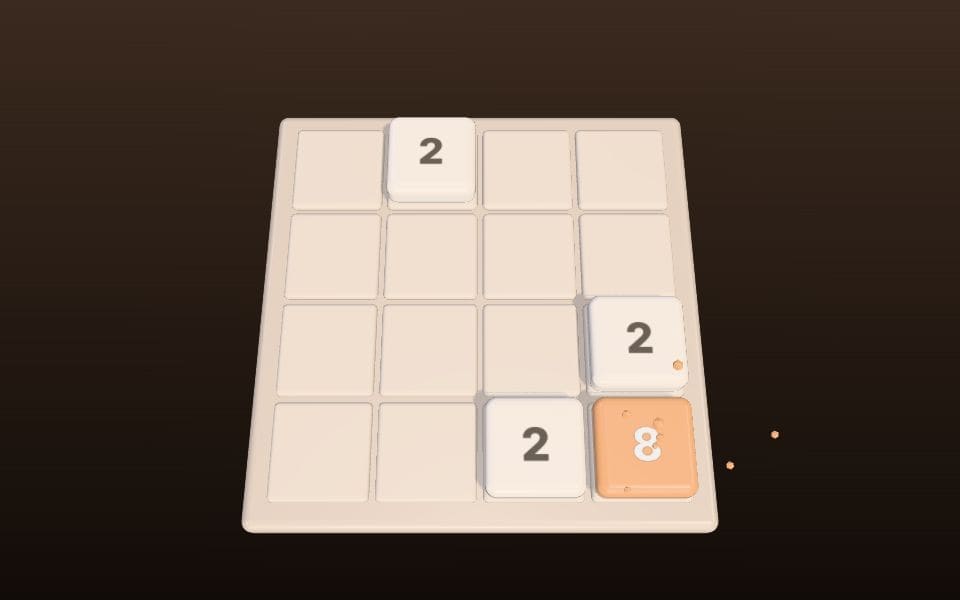
2048 3D: Slide, merge and chase the 2048 tile on a glossy 3D board. It is another puzzle game, so the skills you build in Sudoku carry over.
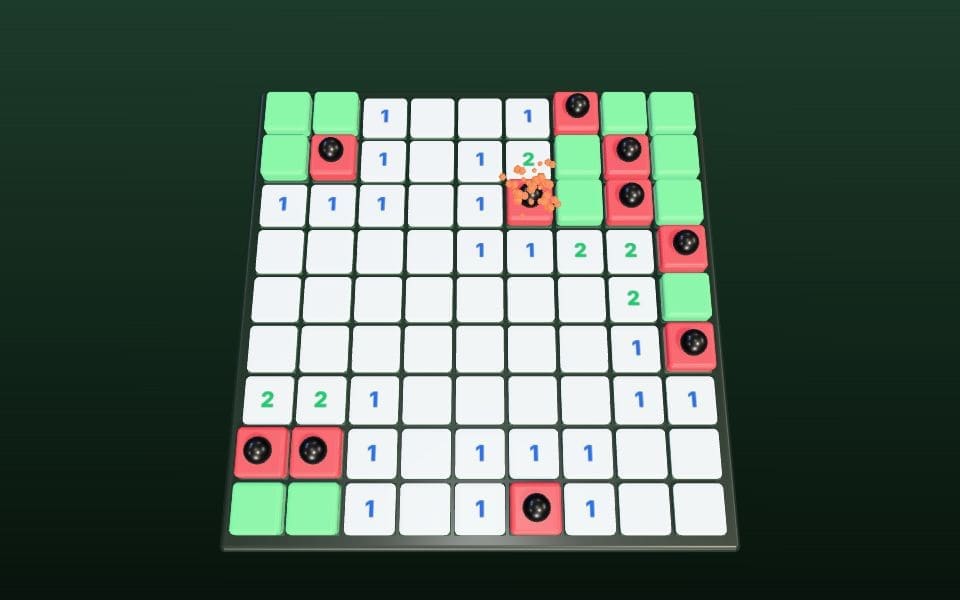
Minesweeper 3D: The classic logic puzzle with raised 3D tiles, flags and satisfying cascades. It is another puzzle game, so the skills you build in Sudoku carry over.
Memory Match: Flip 3D cards, remember the shapes and find every pair before time runs out. It is another puzzle game, so the skills you build in Sudoku carry over.
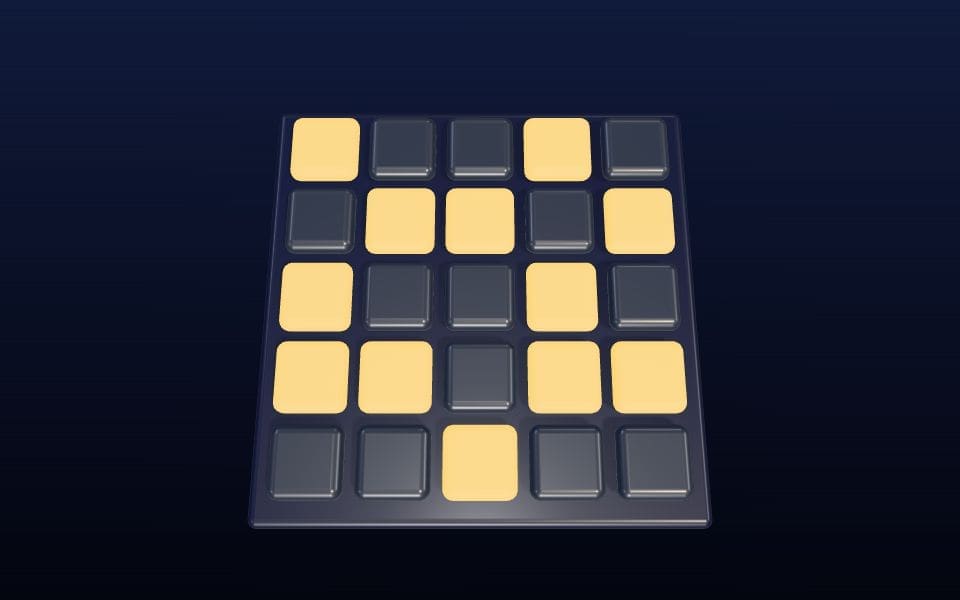
Lights Out: Switch off every glowing light. Each tap flips a light and its neighbours. It is another puzzle game, so the skills you build in Sudoku carry over.
More questions about Sudoku
Is Sudoku free to play?
Yes. Sudoku is completely free on Xons Play, with no download, no account and no in-game purchases. The site is supported by advertising.
How long does a game of Sudoku take?
A typical session lasts 3 to 25 minutes per level. You can stop at any time and your best score stays saved on this device.
Is Sudoku hard?
We rate it medium, 3 out of 5. The basics are quick to learn, and there is plenty of depth to explore.
Can children play Sudoku?
Yes. Sudoku has no violent or adult content. It is a single-player game, so there is no chat with strangers.
Does Sudoku work offline?
The page needs an internet connection to load. Once a game has started, single-player games keep running even if the connection drops briefly.
Sudoku FAQ
How hard are the puzzles?
Level 1 is very easy; the puzzles get harder level by level up to expert.
Is this open source?
The puzzle generator follows the approach of the open source sudoku.js by Rob McGuire-Dale (MIT License), with an added check that every puzzle has exactly one solution.
We use cookies and similar technologies to keep you signed in to games, measure traffic and show ads (including personalised ads by Google). See our Cookie Policy.